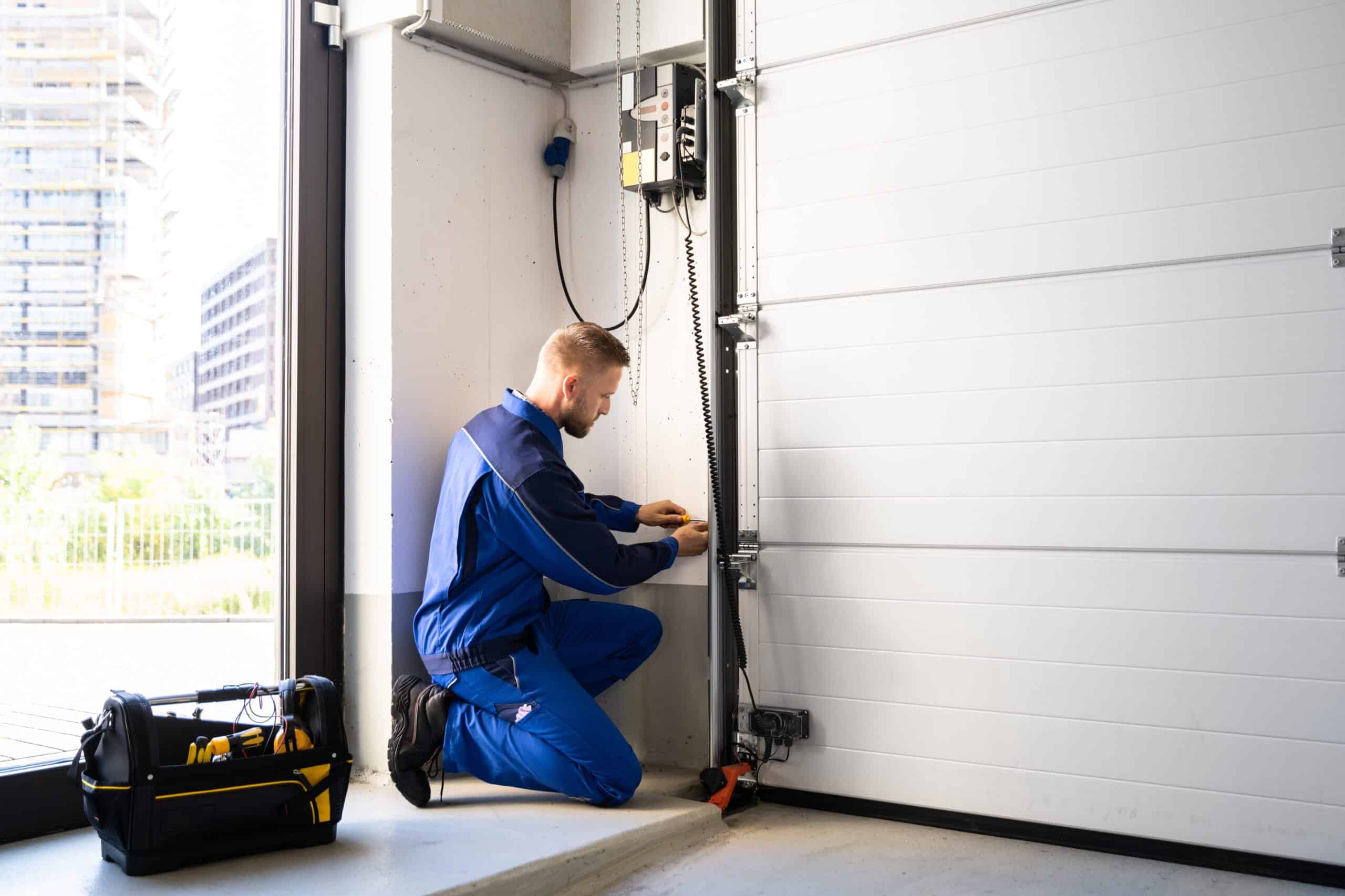
It usually happens without warning. You’re inside, and there’s a bang from the garage loud enough to sound like a gunshot or something falling off a shelf. Later, you hit the opener and the door groans, lifts a few inches, and stops. Nine times out of ten, that’s a broken garage door spring.
A broken spring is one of the most common garage door repairs we handle in Orlando, and it’s also one of the most dangerous to tackle yourself. Here’s how to confirm what happened, what to do in the next few minutes, and what to expect when you call for help.
Signs your garage door spring broke
- A loud bang from the garage, often while nobody was using the door. Springs are under constant tension, so they can snap while the door is sitting closed.
- A gap in the torsion spring. Look at the spring mounted on the bar above the door. A broken one shows a clear gap of an inch or two where the coil separated.
- The door only lifts a few inches, or the opener strains, clicks, or stops shortly after starting.
- The door feels extremely heavy. A balanced door should be fairly easy to lift by hand. With a broken spring, it can feel like it weighs a few hundred pounds, because it does.
- The door goes up crooked, or one lift cable is slack or hanging loose.
- On older doors with extension springs (the long springs running alongside the overhead tracks), one spring looks stretched out, is hanging, or is missing entirely.
What to do right now
- Stop using the opener. Openers aren’t built to lift the full weight of the door. Running it can strip the drive gear, burn out the motor, or fray the cables, turning a spring job into a bigger repair.
- Keep people, pets, and cars clear of the door. A door with a broken spring can drop suddenly if anything else gives way.
- If the door is closed, leave it closed. That’s the safest position. Use another exit for now.
- If the door is stuck open, don’t try to force it down. Don’t pull the red emergency release either. Without spring tension, the door can come down hard.
- Snap a quick photo of the springs above the door and the label on your opener. It helps us bring the right parts the first time.
- Call a garage door technician. Most spring replacements are finished in a single visit.
What not to do
We understand the temptation to save a service call. But a few DIY moves we see send people to urgent care every year:
- Don’t try to wind or unwind a torsion spring. The other spring on the shaft is still loaded with serious torque. Winding requires purpose-made bars and a spring sized to your door’s exact weight.
- Don’t loosen the set screws, cable drums, or bottom brackets. Those parts hold tension. Loosening the wrong one can release it all at once.
- Don’t try to lift the door alone to get a car out. If you absolutely must, use two strong adults, lift from the bottom section, and secure it with locking pliers clamped on the track below a roller. Then call us.
- Don’t buy springs online and hope for the best. Spring wire size, inside diameter, and length all have to match the door’s weight and height.
Why garage door springs break
Springs are a wear item, just like tires. Every time your door opens and closes, the spring twists and relaxes. That’s one cycle, and every spring is rated for a set number of them. A few things shorten that life here in Central Florida:
- Humidity and rust. Rust creates weak points and adds friction between the coils. Our climate makes this the biggest local factor.
- Heavy use. If the garage is your main entrance, your door may cycle six to ten times a day.
- No maintenance. Springs that are never lubricated or inspected wear faster.
- The wrong spring for the door. Undersized springs from a previous repair, or a door that’s been made heavier with added hardware or insulation, put extra stress on the coil.
How long do garage door springs last?
Most standard torsion springs are rated for about 10,000 cycles. High-cycle springs are available rated for 20,000 cycles or more. How long that lasts depends almost entirely on how often your household uses the door:
| Door cycles per day | Standard 10,000-cycle spring | High-cycle 20,000-cycle spring |
|---|---|---|
| 2 (light use) | About 13 years | About 27 years |
| 4 (typical family) | About 7 years | About 13 years |
| 6 (garage is the main entrance) | About 4.5 years | About 9 years |
| 10 (very heavy use) | Under 3 years | About 5.5 years |
Those are rated numbers. In real-world Florida conditions, rust and missed maintenance often pull them down. If you use your garage as the front door, high-cycle springs are usually worth the modest upcharge, and it’s worth asking about when you get a quote.
If one spring broke, replace both
Most double-car doors have two torsion springs that were installed on the same day and have done the same number of cycles. When one breaks, the other is usually close behind. Replacing both at once keeps the door balanced and saves you a second service call a few weeks or months later.
How fast can it be fixed, and what does it cost?
We carry common torsion and extension springs and cables on our trucks, so most spring replacements are done same day in a single visit. On-site, a standard torsion spring replacement takes about 45 minutes to an hour, including balancing the door, testing the opener, and lubricating the hardware.
For pricing, most Orlando homeowners can expect roughly $150 to $275 for a single-car door and $200 to $350 for a double-car door. We break down exactly what drives that number in our guide to garage door spring replacement cost in Orlando. Either way, you’ll get an upfront price before any work starts.
If your door won’t close for a different reason, our guide to why a garage door won’t close walks through the other common causes.
Same-day spring replacement across Orlando
Grade A Garage Doors is a locally owned Orlando company that’s been replacing garage door springs since 2012. Owner Adam and our technicians will tell you exactly what broke, what it costs to fix, and whether anything else needs attention, without the upsell.
We serve homeowners across the metro, including Lake Nona, Winter Park, Oviedo, Baldwin Park, and Maitland.
See our garage door spring replacement service →
Or call (407) 285-4220, 7 days a week, 7am–7pm.
Frequently Asked Questions: Broken Garage Door Springs
Can I open my garage door with a broken spring?
It is not recommended. Without the spring, the door can weigh several hundred pounds and can drop without warning. Using the opener can damage the motor and gears. If you absolutely must get a car out, use two adults, lift from the bottom, and secure the door with locking pliers on the track, then call a technician.
Is a broken garage door spring an emergency?
It is urgent rather than dangerous, as long as you leave the door alone. If the door is closed, your home is secure and you can wait for a technician. If the door is stuck open or a car is trapped inside, call for same-day service.
How long do garage door springs last in Florida?
Standard torsion springs are rated for about 10,000 cycles, which is roughly 7 years for a household that opens and closes the door about four times a day. Florida humidity and rust can shorten that. High-cycle springs rated for 20,000 cycles or more roughly double the lifespan.
Should I replace one garage door spring or both?
Both, if your door has two. The springs were installed together and have the same wear, so the second one usually fails soon after the first. Replacing both keeps the door balanced and saves a second service call.
How long does garage door spring replacement take?
A standard torsion spring replacement takes about 45 minutes to an hour on site. If the cables were damaged when the spring snapped, add another 15 to 20 minutes. Grade A Garage Doors carries common springs on every truck, so most jobs are done in one visit.